
GART
Real-time events analysis platform for traffic information.
Executive Summary
GART (Gateway Agenzia Radio Traffic) is a complete ecosystem for collecting, processing and distributing real-time traffic and mobility information. It integrates multiple data sources (CCISS, DATEX II, ASPI, TMC) using a microservices and serverless architecture on AWS and exposes public APIs for partners such as HERE and TomTom.
project
real-time events analysis platform — gateway for ingestion, normalization and distribution of traffic data.
key features
- 18 microservices organized in functional layers
- Multi-source integration: CCISS, DATEX II, ASPI, TMC, GTFS
- Serverless-first on AWS (Lambda, EventBridge, SQS/SNS)
- Public APIs with rate limiting for external clients
- Multilanguage support (IT/EN/DE) and TMC geocoding
technologies
API Gateway, AWS Lambda, ECS/Fargate, RESTHeart, MongoDB Atlas, CloudFront, S3, EventBridge, SQS/SNS, Angular frontend
What is Radio Traffic Agency?
Radio Traffic is part of the ACI Group and it's specialized in traffic data and news. The media it uses to communicate are audio and video news, dynamic maps and Web applications. Their goal is to keep users up to date on traffic data and to publish the latest information about mobility conditions.
Traffic information is provided in real time through interactive maps and navigation services, with a direct and always updated data flow.
Targets
The management of a large multitude of data, such as those on national mobility, can be an important challenge.
Radio Traffic turned to us because they had critical issues with their legacy software: an expensive maintenance, a fast loss of effectiveness of the technologies used, security risks and a excessive Time to Market. They had an immediate need for a platform of new generation!
The main goal was to develop a stable and fast platform, capable of supporting a bulk of data, coming from different sources, and outgoing data for all connected users from different devices on different platforms: they wanted to enter the "API Economy" age.
How to create such complex software?
Organizing activities in short two-week development cycles each, to optimize the product's inception.

Solution
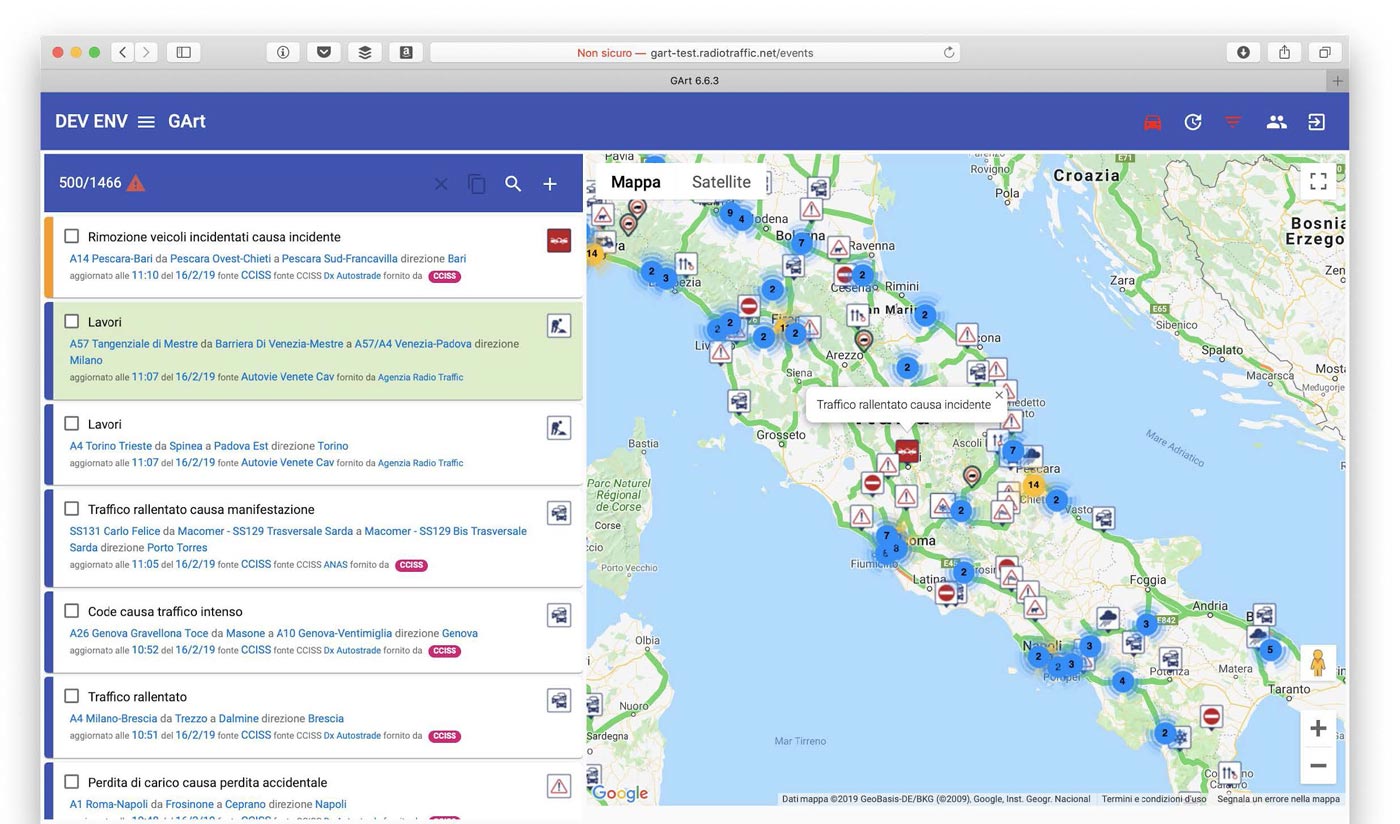
To meet our customer's needs we created GArt, that in just over 6 months became a complete and operational solution.
We have built an infrastructure capable of managing and presenting contents and events to a very high number of users.
GArt retrieves information from external sources: municipal police, 118 emergency, motorway concessionaires, CCISS, ANAS, ACI, ENAC and Civil Protection.
These data are connected via APIs to different channels, such as the web portal, totems, newsletters and mobile applications.
Results
- Platform delivered and operational in just over 6 months.
- 18 microservices across 5 functional categories.
- 12+ AWS Lambda functions and ECS/Fargate services for different workloads.
- Multi-source ingestion (6+ sources) and public clients (HERE, TomTom, Radio24, VIT).
- Handled volumes: ~10,000+ events/day; data freshness < 5 minutes.
- API response time < 500ms (95th percentile); availability 99.9%.
- Reduced costs and faster time-to-market thanks to RESTHeart and serverless approach.
For technical details and architecture diagrams, see the GART technical documentation and repositories.
Technologies
GArt is a product distributed as a microservices architecture, deployed in the Cloud on AWS and developed in Continuous Delivery for a rapid time to market.
The user interface is developed through Angular, while the backend in Java and Node.js.
The system is packaged through Docker containers on a ECS cluster and it is built on top of our main product, called RESTHeart, that in turns exposes a MongoDB Atlas Cloud database via a full REST API.